Tuesday, October 16, 2012

Big Surprise of Worldwide Leading Cisco Supplier -Router-switch.com, Only 15 Days Left!

With providing 59%-77% OFF for hundreds of popular Cisco products and  several free AIR-LAP1131AG-A-K9 for lucky guys fill out the questionnaire, Router-switch.com has proved the company strength and its sincerity to clients. Of course, as many clients required, helping them to know Router-switch.com better is necessary! 

Router-switch.com has become a world’s leading Cisco supplier over the past ten years with the help of its staff and customers. To celebrate its 10 years, router-switch.com offers some activities for all the old and new clients, for example, big discount (save up to 75% off) for the popular Cisco items (including Catalyst 3560x Series, Cisco Catalyst 3750x Series, Catalyst 3560V2/3750V2, Cisco 2900&3900 Routers, Network Cards, etc.), fill out a simple survey to win a big gift (Cisco AIR-AP1131AG-A-K9, limited edition T-shirts and 20PC U disk). The activity date is from September. 01. 2012 to October. 31. 2012. Wow, if you are a Cisco buyer, don’t miss this chance. Let’s join the party to celebrate the 10th birthday together. 
How to Take Part in this Big Party for Router-switch.com’s 10th Anniversary?
If you want to know more about the activities hold at router-switch.com, you can visit the related topics: Big Discount for the Popular Cisco Items.
http://www.router-switch.com/10years/crazy-sale-of-10th-anniversary.html,

Fill Out the Questionnaire to Get a Big Gift, 
 http://www.router-switch.com/10years/questionnaire.html.

How the Router-switch.com Become the World’s Leading Cisco Supplier?
During the past ten years, from 2002 to 2012, router-switch.com has grown up into a global leading Cisco supplier. Indeed, it has experienced several vital moment. Here let’s share some router-switch.com’s big events:
2002, Router-switch.com was founded.
2003, Router-switch.com has experienced a rapid development.
2004, CCIE technical support team was built.
2005, the sales volume maintains 70% growth per year.
2006, Staff in company increased to 20.
2007, Router-switch.com established its marketing department. It attained its reputation in providing timely information of Cisco for clients and Cisco users.
2008, Router-switch.com adopted necessary advanced management tools to improve its service for clients.
2009, Router-switch.com upgraded warehouses in Hongkong and Mainland China. Its inventory is worth over $5 million.
2010, the sales of Router-switch.com have zoomed to $ 30 million.
2011, Router-switch.com released the new version to update service. It supplies free CCIE support. Social network platforms were opened to communicate with customers and clients well.
2012, New Office of router-switch.com landed in US to offer professional local service.
Nowadays, router-switch.com is becoming the world’s largest Cisco reseller online.  It believes that router-switch.com will be more professional, more reliable and stronger with your support.
Note: A letter from CEO of router-switch.com to thank its customers and share their progress.
More about Router-switch.com:
Router-switch.com, also called Yejian Technologies Co., Ltd, is the worldwide leader in delivering new, used, refurbished Cisco hardware, including Cisco routers, Cisco switches, firewall security, Cisco IP Phones VoIP, wireless AP, Cisco modules & cards, memory, and optical cables, SFP, GBIC, XENPK , etc. It carries over $5 million in inventory of Cisco hardware and Cisco equipment that can meet SOHO, small, midsized and large businesses of all sizes. Also Router-Switch.com owns more than 8,000 customers worldwide, not only because of its original Cisco products with reliable quality and competitive price, but also due to professional service, huge inventory, flexible payment and shipment. More information about router-switch.com can be found at http://www.router-switch.com/. For ongoing Cisco info, please go to
Blog.router-switch.com---News, tutorials, tips, info & thoughts on Developments in the Cisco, Cisco network, IT, Software & Network Hardware Industry
More Related Router-switch.com News:
Router-switch.com Announced Its Newly Redesigned Website
“Router Switch”, Our New Company Landing in U.S.—Professional Cisco Supply Service is Around You
Router-switch.com: A Batch of New Cisco Network Equipment Surprises the Coming Christmas Day
Router-Switch.com Uploaded Thousands of New Cisco Products

Wednesday, August 15, 2012

Tutorial of Definition and Functions of Cisco Network Access Control (NAC)


What is NAC?
NAC, as the abbreviation of Network Access Control or Network Admission Control, is a method of bolstering the security of a proprietary network by restricting the availability of network resources to endpoint devices that comply with a defined security policy. Of course, this definition may not summary NAC very well which is result in many misunderstandings. Some view NAC as simple registration and authorization of network connected end systems, while others treat NAC as a solution to protect the network environment from viruses and worms; there are also some view NAC as a gatekeeper function to control how end systems and guest systems, which are not compliant with corporate computing guidelines, can access the network. In fact, a well architected NAC solution is actually all of these things. Network Access Control is the integration of several technologies to provide a solution that proactively and reactively controls end system communication on the network. A well architected NAC solution will leverage a number of important functions including end system detection, authentication, assessment, authorization, and remediation. This more easily enables IT organizations to quickly deploy NAC, and more importantly, to enable phased deployment to best align with business needs.
Functions of NAC
There are a number of individual functions that make up a comprehensive NAC solution. A well architected solution should integrate highly advanced, policy-enabled network infrastructure, along with advanced security applications and centralized management to deliver all of the required functions for pre and post-connect secure network access. Now, let’s share the details on Detection and identification of new devices connecting to the network step by step. 
 
1. Authenticate - Authentication of users and/or devices. A traditional network access server (NAS) is a server that performs authentication and authorization functions for potential users by verifying logon information. In addition to these functions, NAC restricts the data that each particular user can access, as well as implementing anti-threat applications such as firewalls, antivirus software and spyware-detection programs. NAC also regulates and restricts the things individual subscribers can do once they are connected.
2. Assese - Assessment of end systems regarding their compliance and/or vulnerabilities. The access-control policy in NAC could range from simple, such as a go/no-go decision on network access or a choice of virtual LANs, or it could be as complex as a set of per-user firewall rules defining which parts of the network are accessible. Besides, the function of assessment goes beyond the switch port and tries to assess the end system itself. Assessments, or health-checks, can be separated into two methods: Agent-less (Network Based - a network scanner scans the end system remotely over the network; Applet Based - a java applet is used to launch assessment functions on the end system (web browser based) or Agent-based (Thin Agent - a temporary agent which can be loaded and unloaded on the end system using various vendor-specific techniques; Fat Agent - a persistent suite of assessment software with firewall and host intrusion detection established on the end system)
3. Authorize - Authorization to use the network based on the results of the authentication and the assessment. The authorization process applies all the rules planned during the preparation phase of a NAC deployment. Additionally, choice of authorization enforcement options also depends on the required level of security as well as the design of the infrastructure itself. It is important to know if more than one end system needs to share ports or if devices, users, ports, or individual traffic flows need to be considered.
4. Monitor - Monitoring users and devices once they are connected to the network. The NAC solution should include a general variety of configuration options to meet the requirements of the network. The chosen NAC solution should work flexibly but based on templates to keep administrative effort at a minimum and simplify troubleshooting. 
 5. Contain-You should quarantine problem on end systems and/or users to prevent them from negatively impacting the overall network environment.
6. Remediate - Remediation of problems with the end system and/or user. Remediation is the process of supporting end systems to reach the required level of compliance and to then offset restrictions to the network. To minimize the manual remediation process, problems with end systems and user actions should be solved automatically or by the user rather than forcing involvement of the IT helpdesk.
With embarking on a project to implement NAC, there are a few major business benefits you can accomplish with the NAC solution for those fundamental elements for a NAC project can determine who is allowed to connect to the network; How are they allowed to communicate; what are they allowed to connect to; and where should they get access.
Some materials are referred from:
www.enterasys.com/company/literature/enterasys-nac-guide.pdf

Friday, August 10, 2012

Tutorial of Creating No-Router Wireless Network with Wi-Fi or ad-hoc Network

The co-operation between persons is becoming stronger and stronger in this Internet time. So does the shared materials. Imagine that you want to share your internet accessibility options with other notebooks or desktops in your room with all your friends or colleagues, but you have to do a series of connection with routers or access points. Thus, leaving apart internet is the trend. But how to create a wireless network without applying routers is a problem. There are two ways you can choose: by Wi-Fi or ad-hoc network.

First, let’s make clear what is the different between Wi-Fi and ad-hoc network.
1. Generally, to set up Ad Hoc networking, your main computer needs to have an Ethernet based Internet connection as well as a Wireless (WLAN) network adapter. But in the case of Virtual Wi-Fi, the Ethernet card is optional so you can turn a laptop into a hotspot even if your laptop itself is connected to a Wireless network and not to an Ethernet cable.
2. Computers and other wireless devices in ad hoc networks must be within 30 feet of each other but there’s no such restriction in the case of Virtual Wireless networks.
3. Ad-Hoc wireless networking is available on Windows XP, Vista and Windows 7 while Virtual WiFi, which is much easier to setup, is available on Windows 7 or Windows Server 2008.

Second, let’s share the advantages and disadvantages of no-router wireless network.
Advantage:
1. It is easy to setup with no additional Software being needed
2. It's Free without purchasing any hub or routers or service.
3. Nowadays, by default Wi-fi or Wireless Card is included when you bought a computer especially in laptops.
4. It has strong portability and mobility
Disadvantage:
1. The computer that is connected to the Internet (Gateway) must always be turned on. Unlike using a router, you can turn off any computers in the network.
2. Wireless communication quality and the Data safety performance are not so well as Bluetooth.  
3. Its distance and range are limited.

Third, let’s come to the steps of creating no-router wireless network
1. Choose a computer to use as a router, which must be operating for any other computers or devices to connect to the network.
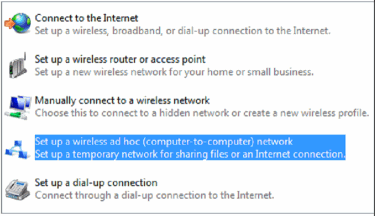
2. In the Control Panel, click on “Network and sharing center”.  Select “Set up a connection or Network”.

3. Choose “Set up a wireless ad-hoc (computer-to-computer) network” and click on it. If the box is grayed out, press "Advanced" in the "Wireless Networks" tab and choose "Computer to computer (ad hoc) network."

4. Type a name for the network. Choose whether to use a wireless network key or not.
5. Always remember to make the security type “WPA-2 Personal”. Notify that this security type prevails over other types since it enables genuine wireless network security.
6. Make sure you select “Save this network” option else the ad hoc network will be removed if no other computers / devices are connecting to the network. 

(You can also choose your network type as “WEP”. Give a preferred network name and chose the “Security type” as “WEP”. The next step deals with providing a security key to the network to be built.)
7. Enable ICS on the router computer, which will allow you to share your Internet connection.
Right click your Internet connection and then choose "Advanced." Check the "Allow other network users to connect through this computer's Internet connection" check box. Choose "Wireless Network Connection" and press "OK."
8. Select the shared network from other computers to connect. Right click the wireless networks icon in the notification tray. Press "View Available Networks." Select the appropriate network name and press "Connect."

Additionally, if you are on Windows 7, you can instantly turn your computer into a personal Wi-Fi hotspot without having to configure anything. All you need is the free software called Virtual Router and the computer connected to the internet must be running Windows 7.

Referred link:  
www.techtipsgeek.com/create-wireless-home-network-router-windows-7vista/5182/